
Bohr's Postulates, Hydrogen Energy Levels, and Spectral Lines Explained

30.1 BOHR'S POSTULATES
30.1.1 Production of the Emission Line Spectrum of Hydrogen Gas
Method
 |
| Figure 30.1: Experimental setup showing discharge tube, slit, light, prism, screen, and hydrogen spectrum |
- Set up the apparatus as shown in Figure 30.1 in a dark room.
- Light from a discharge tube containing hydrogen gas is allowed to pass through a glass prism.
- A spectrum of the hydrogen light will be produced on a screen.
The hydrogen spectrum
 |
| Figure 30.2: Spectrum showing parallel coloured spectral lines |
The spectrum consists of a few parallel coloured lines against a dark background, as shown in Figure 30.2.
30.1.2 Model of Hydrogen Atom
- A neutral hydrogen atom is composed of an electron and a proton.
- The classical model of a neutral hydrogen atom states that the electron moves in a circular orbit, with the proton situated at the centre of the circle.
30.1.3 The Bohr Model of the Hydrogen Atom
The classical model of the neutral hydrogen atom is enhanced by Niels Bohr. The Bohr model of the hydrogen atom has several features, which are described by the postulates stated below:
- The electron can only exist and move in certain allowed orbits. The total energy of the electron in an allowed orbit is constant. This means that the electron does not radiate energy as long as it remains in the orbit.
-
The atom radiates energy only when the electron jumps from one allowed orbit to a smaller allowed orbit. The amount of energy $\Delta E$ radiated is given by
$$\Delta E = hf$$
where $h$ is the Planck constant, $f$ is the frequency of the radiation.
Furthermore, $$\Delta E = E_i - E_f$$ where $E_i$ is the energy of the atom in the initial allowed orbit and $E_f$ is the energy of the atom in the final allowed orbit. - The angular momentum of the electron about the nucleus in an allowed orbit is quantized. The magnitude of the angular momentum $L$ can only be an integral multiple of $h/2\pi$. $$L_n = n\left(\frac{h}{2\pi}\right)$$ where $n = 1, 2, 3, \dots$
30.2 ENERGY LEVELS IN AN ATOM
30.2.1 Energy of an Atom
The total energy $E$ of an atom with atomic number $Z$ is given by $$E = K + U$$ where $K$ is the kinetic energy of the electron orbiting the nucleus, $U$ is the electric potential energy of the electron-proton system.
We have $$K = \frac{1}{2}mv^2$$ where $m$ is the mass of the electron, $v$ is the tangential linear velocity of the electron in the orbit.
We have $$U = qV = (-e)\frac{k(+Ze)}{r} = -\frac{kZe^2}{r}$$ where $e$ is the charge of the electron, $r$ is the radius of the allowed Bohr orbit, and $$k = \frac{1}{4\pi\varepsilon_0}$$ where $\varepsilon_0$ is the permittivity of free space. Hence, the total energy is $$E = \frac{1}{2}mv^2 - \frac{kZe^2}{r}$$
Since the electron moves in a circle, it is acted on by a centripetal force $F$ given by $$F = \frac{mv^2}{r}$$
This force is provided by the attractive electric force $F_E$ which is given by $$F_E = \frac{kZe^2}{r^2}$$ We have $$F = F_E$$ $$\frac{mv^2}{r} = \frac{kZe^2}{r^2}$$ $$mv^2 = \frac{kZe^2}{r}$$
$$K = \frac{1}{2}mv^2 = \frac{kZe^2}{2r}$$ Hence, the total energy is $$E = \frac{kZe^2}{2r} - \frac{kZe^2}{r}$$ $$E = -\frac{kZe^2}{2r}$$
30.2.2 Radius of the Bohr Orbit
We can rewrite the equation for the total energy of a neutral atom given above in terms of the quantum number $n$. According to one of the Bohr postulates, the angular momentum $L_n$ of the electron about the nucleus is given by $$L_n = n\left(\frac{h}{2\pi}\right)$$
But the angular momentum is defined as $$L = mvr$$ Hence, $$mvr = n\left(\frac{h}{2\pi}\right)$$ $$v^2 = \frac{1}{m^2r^2}\left(\frac{nh}{2\pi}\right)^2$$ $$mv^2 = \frac{1}{mr^2}\left(\frac{nh}{2\pi}\right)^2$$ But, $$mv^2 = \frac{kZe^2}{r}$$ Hence, $$\frac{kZe^2}{r} = \frac{1}{mr^2}\left(\frac{nh}{2\pi}\right)^2$$ $$\frac{1}{r} = mkZe^2\left(\frac{2\pi}{nh}\right)^2 = m\left(\frac{1}{4\pi\varepsilon_0}\right)Ze^2\left(\frac{2\pi}{nh}\right)^2 = \frac{mZe^2\pi}{\varepsilon_0}\left(\frac{1}{nh}\right)^2$$
The radius $r_n$ of the Bohr atom of quantum state $n$ is given by $$r_n = \left(\frac{h^2\varepsilon_0}{Zme^2\pi}\right)n^2$$
Orbits of hydrogen atom:
For hydrogen atom of quantum state $n = 1$, the radius $r_1$ is the smallest. Its value is $$r_1 = \frac{h^2\varepsilon_0}{me^2\pi} = 0.0529\text{ nm}$$ The other larger orbits are given by $$r_2 = 2^2 r_1 = 4r_1$$ $$r_3 = 3^2 r_1 = 9r_1$$ and so on. Figure 30.3 shows several of those allowed orbits of the hydrogen atom.
[Insert Figure 30.3: Allowed orbits of the hydrogen atom for $n = 1, 2, 3, 4$]
30.2.3 Energy of Quantum State $n$ of an Atom
The total energy $E_n$ of quantum state $n$ is $$E_n = -\frac{kZe^2}{2r}$$ $$= -\frac{kZe^2}{2}\left(\frac{1}{r}\right)$$ $$= -\frac{kZe^2}{2}\left[mkZe^2\left(\frac{2\pi}{nh}\right)^2\right]$$ $$= -\frac{2mk^2Z^2e^4\pi^2}{h^2}\left(\frac{1}{n}\right)^2$$ But, $k = \frac{1}{4\pi\varepsilon_0}$ $$E_n = -\frac{2mZ^2e^4\pi^2}{h^2}\left(\frac{1}{4\pi\varepsilon_0}\right)^2\left(\frac{1}{n}\right)^2$$ $$E_n = -\frac{Z^2e^4m}{8\varepsilon_0^2h^2}\left(\frac{1}{n}\right)^2$$
30.2.4 The Energy of the Quantum State $n$ of a Hydrogen Atom
-
The energy of quantum state $n$ of a hydrogen atom.
Those constants in $E_n$ have the following values: $Z = 1$; $m = 9.11 \times 10^{-31}\text{ kg}$; $e = -1.6 \times 10^{-19}\text{ C}$; $\varepsilon_0 = 8.854 \times 10^{-12}\text{ F m}^{-1}$; $h = 6.63 \times 10^{-34}\text{ J s}$.
Substitute these values into the equation above. We get $$\frac{Z^2e^4m}{8\varepsilon_0^2h^2} = 21.67 \times 10^{-19}\text{ J} = 13.6\text{ eV}$$ The energy $E_n$, in eV, of the atom in quantum state $n$ is given by $$E_n = -13.6\left(\frac{1}{n}\right)^2\text{ eV}$$ where $n = 1, 2, 3, \dots$
-
The ground state of hydrogen atom
- The lowest energy state of the atom is known as the ground state.
- The atom is in the quantum state of $n = 1$.
- For the hydrogen atom, the energy of the atom in ground state is $$E_1 = -13.6\left(\frac{1}{1}\right)^2 = -13.6\text{ eV}$$
-
The excited states
The atom in the quantum state of $n > 1$ is said to be in the excited state. For example, in the excited state of $n = 3$, the atom has energy of $$E_3 = -13.6\left(\frac{1}{3}\right)^2 = -1.51\text{ eV}$$ -
The ionised state
- An ion is a charged atom or molecule which has either lost or gained one or more electrons.
- Ionisation is the process of producing ions.
- The minimum amount of energy required to remove an electron from a neutral hydrogen atom is known as the ionisation energy.
- The hydrogen ion is in the quantum state of $n = \infty$.
- The energy $\Delta E$ needed to remove the electron from the atom is the difference between the energy of the ground state of $n = 1$ and the state of $n = \infty$. Hence, the ionisation energy for the hydrogen atom is $$\Delta E_{\infty - 1} = -13.6\left[\left(\frac{1}{\infty}\right)^2 - \left(\frac{1}{1}\right)^2\right] = 13.6\text{ eV}$$
30.2.5 The Energy Level Diagram
[Insert Figure 30.4: Energy level diagram of hydrogen atom from $n = 1$ ($-13.6\text{ eV}$) to $n = \infty$ ($0\text{ eV}$)]
For the hydrogen atom, the energy of the atom is given by $$E_n = -13.6\left(\frac{1}{n}\right)^2\text{ eV}$$
The atom of quantum states $n = 1, 2, 3, 4, 5, \dots$ has the following energy values:
| $n$ | $E_n\text{ (eV)}$ |
|---|---|
| 1 | $-13.6$ |
| 2 | $-3.40$ |
| 3 | $-1.51$ |
| 4 | $-0.85$ |
| 5 | $-0.54$ |
| 6 | $-0.38$ |
| $\vdots$ | $\vdots$ |
| $\infty$ | $0$ |
Each value of $E_n$ can be represented by a horizontal line. If these lines are drawn beside a vertical energy scale, we will obtain a diagram which looks like the one shown in Figure 30.4. This diagram is known as the energy level diagram. Each line represents the energy level of the atom.
30.3 SPECTRAL LINES
30.3.1 Electronic Transition in Hydrogen Atom
- A hydrogen atom of some quantum state (e.g. $n = 1$) can absorb a discrete amount of energy and gets itself into another quantum state (e.g. $n = 2$, or $3$). The atom in the new excited state would like to get back to the normal state or another state at lower energy level. This is allowed and can be done by emitting the energy absorbed earlier. This process, in which an atom changes its quantum state to another by absorbing or emitting certain discrete amount of energy, is known as an electronic transition.
- The energy emitted by the atom during a transition is carried away by a photon of electromagnetic radiation.
[Insert Figure 30.5: Energy level diagram showing downward transitions and emitted photons]
-
An electronic transition can be depicted in the energy level diagram. A vertical arrow is drawn between the two energy levels which are involved in the transition. It points downwards to represent the electronic transition from a higher energy level to a lower energy level. Figure 30.5 shows an energy level diagram with a few arrows drawn in it to represent electronic transitions. The following are the transitions shown:
Since each arrow points downwards, energy is emitted by the atom in each transition. The energy emitted is carried away by a photon.Initial state Final state $n = 2$ $n = 1$ $n = 3$ $n = 1$ $n = 3$ $n = 2$ $n = 4$ $n = 2$ $n = 4$ $n = 3$
30.3.2 The Energy Emitted in a Transition
Suppose a hydrogen atom is in an initial quantum state of energy $E_i$. It undergoes transition so that its final quantum state is of energy $E_f$. The amount of energy $\Delta E$ absorbed / emitted is given by $$\Delta E = E_f - E_i$$
The energy emitted is carried away by a photon of electromagnetic radiation. The energy of the photon is equal to $\Delta E$. $$\text{energy of photon} = \Delta E$$
The energy of a photon is $hf$ where $f$ is the frequency of the emitted electromagnetic radiation. Hence, we have $$\Delta E = hf$$
The speed of the electromagnetic radiation is $$c = f\lambda$$ where $\lambda$ is the wavelength of the radiation. Hence, $$\Delta E = \frac{hc}{\lambda}$$
EXAMPLE 30.1
Figure 30.6 shows five energy levels of an atom. Which transition, $A$, $B$, $C$ or $D$, produces emission of electromagnetic radiation with the shortest wavelength? Explain.
[Insert Figure 30.6: Five energy levels $P$, $Q$, $R$, $S$, $T$ with transitions $A$, $B$, $C$]
Answer
The energy emitted is given by $$\Delta E = \frac{hc}{\lambda}$$ $$\Delta E \propto \frac{1}{\lambda}$$
If $\lambda$ is the shortest, then $\Delta E$ has to be the largest. The largest amount of energy emitted is brought about by the transition from energy level $S$ to energy level $P$, i.e., transition $A$.
EXAMPLE 30.2
A hydrogen atom in the quantum state of $n = 3$ undergoes transition to the state of $n = 2$. Determine the wavelength of the electromagnetic radiation emitted in this transition.
($h = 6.6 \times 10^{-34}\text{ J s}$; $c = 3.0 \times 10^8\text{ m s}^{-1}$; $e = -1.6 \times 10^{-19}\text{ C}$)
Answer
Energy of state $n = 3$ is given by $$E_3 = -13.6\left(\frac{1}{3}\right)^2 = -1.51\text{ eV}$$
Energy of state $n = 2$ is given by $$E_2 = -13.6\left(\frac{1}{2}\right)^2 = -3.40\text{ eV}$$
The amount of energy emitted is $$\Delta E = |E_2 - E_1| = |(-3.40) - (-1.51)| = 1.89\text{ eV} = (1.89)(1.6 \times 10^{-19}) = 3.02 \times 10^{-19}\text{ J}$$ $$\Delta E = hf = \frac{hc}{\lambda}$$ $$\lambda = \frac{hc}{\Delta E} = \frac{(6.63 \times 10^{-34})(3.0 \times 10^8)}{3.02 \times 10^{-19}} = 6.6 \times 10^{-7}\text{ m}$$
30.3.3 The Hydrogen Spectrum
[Insert Figure 30.7: Hydrogen energy level diagram showing Lyman, Balmer, and Paschen series]
- Figure 30.7 shows the energy level diagram of the hydrogen atom. In it is shown transitions from higher energy levels to the final quantum states of $n = 1$, $n = 2$ and $n = 3$.
- Each transition results in electromagnetic radiation being emitted. This radiation has wavelength $\lambda$ given by $$\lambda = \frac{hc}{\Delta E}$$ Since $\Delta E$ is a discrete amount of energy, it means that the wavelength has a distinct value.
- The radiation could be visible light. If it is visible light and the light is allowed to pass through a slit and then through a prism, then a bright coloured spectral line associated with a particular value of $\lambda$ will be produced on a screen.
- Taking into account all those transitions shown in the diagram, the prism will produce the hydrogen spectrum, which is composed of several parallel coloured spectral lines against a dark background (if the spectrum is viewed in a dark room).
Applications of Bohr's Model & Atomic Spectra
Quantized atomic energy levels and electronic transitions explain how atoms emit and absorb light at specific wavelengths. These principles have important applications in lighting, laser technology, astronomy, and precision timekeeping.
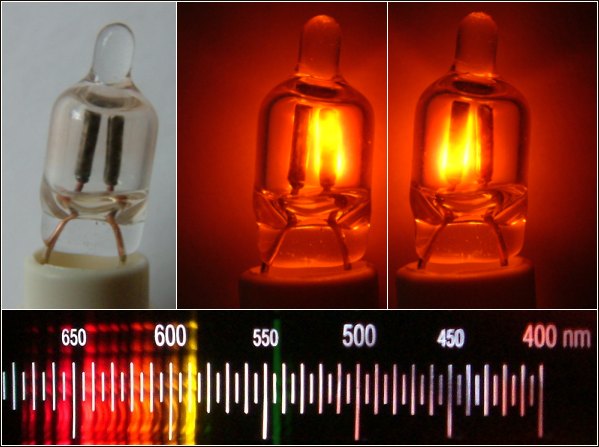
1. Gas Discharge Lamps & Neon Signs
When an electric current passes through a low-pressure gas, collisions excite gas electrons to higher energy levels. As electrons return to lower energy states, they emit photons with discrete energies (ΔE = hf = hc/λ). This produces characteristic emission lines with specific colors.

2. Lasers & Optical Devices
Lasers produce intense, coherent, and nearly monochromatic light through stimulated emission. When an excited atom or active medium undergoes a transition between two energy states, photons of a particular energy are generated. The photon energy is determined by ΔE = hf.

3. Astronomy & Stellar Spectroscopy
Every chemical element has a unique arrangement of energy levels and therefore produces a characteristic spectral fingerprint. By studying absorption and emission lines in starlight, astronomers can determine the chemical composition of distant stars and nebulae.

4. Atomic Clocks & GPS Navigation
Certain atomic transitions have extremely stable frequencies. These frequencies provide highly precise time references. Atomic clocks are essential in satellite navigation because GPS receivers determine their positions using the travel times of signals transmitted by satellites.
Important Physics Note
Bohr's model explains quantized energy levels and spectral lines particularly well for hydrogen and hydrogen-like ions. However, modern technologies also involve more advanced quantum mechanical principles.
Emission vs. Absorption: An atom emits a photon when an electron moves from a higher energy state to a lower energy state. The emitted photon has energy ΔE = Ei - Ef. Conversely, an atom absorbs a photon of matching energy when an electron moves to a higher energy state.
Line Spectra vs. Continuous Spectra: Because atomic energy levels are discrete, electronic transitions produce spectral lines at specific wavelengths, rather than a continuous spectrum. The relationship is λ = hc/ΔE.
Bohr Model Limitations: Bohr's circular-orbit model works accurately for single-electron systems such as H, He+, and Li2+. Multi-electron atoms, fine spectral structures, and chemical bonding require a more complete quantum mechanical description.