17.6 Motion of Charge in Uniform Electric Field
17.6.1 Charged Particles Moving in Direction Parallel to Uniform Electric Field
1. The uniform electric field
A uniform electric field is produced by a pair of flat parallel metal plates separated by a distance d. One plate is applied a positive voltage +V while the other is earthed, as shown in Figure 17.46. We have
(a) Field direction
The electric field lines are parallel, evenly spaced and point away from the positively charged plate.
(b) Magnitude of electric field strength
The magnitude of the electric field strength E is given by
$E=\frac{V}{d}$
2. Direction of electric force
The electric force $F_e$ acting on a particle in the field
(a) always points parallel to the field lines and towards the positively charged plate if the particle carries a negative charge
(b) always points parallel to the field lines and away from the positively charged plate if the particle carries a positive charge
3. Acceleration of particle
Suppose a particle of mass m and carrying a charge q is able to move freely inside a uniform electric field of strength E. Then it will be acted on by a constant electric force $F_e$.
The magnitude of the electric force is given by
$F_e = ma$
But $F_e$ is also given by
$F_e = qE$
Hence we have
$ma = qE$
$a = \frac{q}{m}E$
$a = \frac{q}{m}\frac{V}{d}$
The direction of the acceleration vector a points in the same direction as $F_e$.
4. Equations of motion
The charged particle moves along a linear path in a direction which is parallel to the electric force direction. We can apply the equations for a particle moving with constant acceleration
$v = u + at$
$s = ut + \frac{1}{2}at^2$
$v^2 = u^2 + 2as$
Example 17.26
A p.d. of 100 V is applied across a pair of flat parallel metal plates A and B, separated by a distance of 1.0 cm. An electron emerges from plate A at speed $5.0\times10^6 \ m \ s^{-1}$ and moves towards B in a linear path which is perpendicular to B. Determine
(a) the acceleration of the electron
(b) the speed of the electron when it reaches B
(c) the time taken by the electron to travel to B
For electron, $e/m_e = -1.76 \times 10^{11} \ C \ kg^{-1}$
Answer
(a)
$E = \frac{V}{d}$
$E = \frac{100}{0.01}$
$E = 1.0 \times 10^4 \ V \ m^{-1}$
Acceleration
$a = \frac{qE}{m}$
$a = \frac{1.76 \times 10^{11}}{1.0 \times 10^4}$
$a = 1.76 \times 10^{15} \ m \ s^{-2}$
(b)
$v^2 = u^2 + 2as$
$=(5.0 \times 10^6)^2 + 2(1.76 \times 10^{15})(0.01)$
$v = 7.8 \times 10^6 \ m \ s^{-1}$
(c)
$v = u + at$
$7.8 \times 10^6 = 5.0 \times 10^6 + (1.76 \times 10^{15})t$
$t = 1.6 \times 10^{-9} \ s$
17.6.2 Charged Particle Entering Uniform Electric Field at 90° to the Field
1. The electric field
The uniform electric field is produced by applying a p.d. V across a pair of flat parallel metal plates $P_1$ and $P_2$, which are separated by a distance d, as shown in Figure 17.47. Edge effects are neglected. The magnitude of the field strength E is given by
$E=\frac{V}{d}$

2. Particle motion in field
A negatively charged particle travelling in a horizontal direction at constant speed u enters the electric field. The angle between the velocity and the field is 90°. We can determine the following for the particle moving inside the field.
(a) Force acting on particle
Once the negatively charged particle enters the electric field, it will immediately experience an electric force acting on it. This force has
(i) a direction which always points perpendicularly towards the positively charged metal plate $P_1$
(ii) a magnitude $F_e$ given by
$F_e=qE=q\frac{V}{d}$
where $q$ is the charge carried by the particle.
(b) Acceleration of particle
When the particle moves inside the field, the velocity is going to change continuously because it is acted on by an electric force. The magnitude increases with time and the direction of motion also changes. Hence, the particle has an acceleration $a$, given by
$a=\frac{F_e}{m}$
where m is the mass of the particle. The direction of a always points perpendicularly towards the positively charged plate $P_1$.
(c) Path of motion
We can show that the particle follows a parabolic path in the field.
(d) Instantaneous velocity and its components
The instantaneous velocity $v$ of the charged particle in the field is no longer horizontal because the particle is following a parabolic path. Hence, at any instant it is going to have a horizontal velocity component $v_x$ and a vertical velocity component $v_y$
(i) No external force acts in the horizontal direction (neglect friction), therefore
$v_x=u$
where $u$ is the initial speed of the particle before is enters the field.
(ii) Considering the vertical motion
$v_y=u_y+at$
But $u_y=0$, and so we have $v_y=at$
(iii) The instantaneous velocity $v$ is given by
$v=\sqrt{v_x^2+v_y^2}$
The vector diagram for $v$ is shown in Figure 17.47.
(e) Direction of instantaneous velocity
Let the angle between $v$ and the horizontal be θ. Then we have
$\tan \theta=\frac{v_y}{v_x}=\frac{at}{u}$
(f) Time taken to cross the field completely
The time T taken by the particle to completely travel through the field is given by
$T=\frac{L}{u}$
where L is the length of each of the metal plates.
Example 17.27

Figure 17.48 shows the Y-plates found inside a cathode ray oscilloscope (CRO). An electron moving at a constant speed of $1.5 \times 10^{7} \ m \ s^{-1}$ enters the vertical uniform electric field existing between the plates at an angle of 90°. A p.d. is applied across the plates, with the top plate charged positively at +80 V relative to the bottom plate.
(a) Copy Figure 17.48 and draw the path followed by the electron in between the plates and outside the plates.
(b) Determine the magnitude and direction of the acceleration of the electron in between the plates.
(c) Determine the magnitude and direction of the velocity of the electron when it has passed through the space between the deflecting plates.
$(e/m_e =-1.76 \times 10^{11} \ C \ kg^{-1} )$
Answer
(a) The path of the electron is shown in Figure 17.49.

(b) Refer to Figure 17.50

$F_e=q\frac{V}{d}$
$F_e=ma$
$a=\left(\frac{q}{m}\right)\left(\frac{V}{d}\right)$
$a=(1.76 \times 10^{11})\left(\frac{80}{20 \times 10^{-3}}\right)$
$a=7.0 \times 10^{14} \ m \ s^{-2}$
(c) Refer to Figure 17.51.

The magnitude of velocity is given by
$v=\sqrt{v_x^2+v_y^2}$
$v_x=1.5 \times 10^7 \ m \ s^{-1}$
$v_y=at$
$t=\frac{L}{v_x}$
$t=\frac{60 \times 10^{-3}}{1.5 \times 10^7}=4.0 \times 10^{-9} \ s$
$v_y=(7.0 \times 10^{14})(4.0 \times 10^{-9})$
$v_y=0.28 \times 10^7 \ m \ s^{-1}$
$v=10^7 \sqrt{1.5^2+0.28^2}$
$v=1.53 \times 10^7 \ m \ s^{-1}$
$v =1.5 \times 10^7 \ m \ s^{-1}$
Direction
$tan \ \theta =\frac{v_y}{v_x}$
$tan \ \theta=\frac{0.28}{1.5}$
$\theta =10.6^0$ to the horizontal
17.6.3 Charged Particle Entering Uniform Electric Field at Less than 90°

1. The electric field
The uniform electric field is produced by applying a p.d. V across a pair of flat parallel metal plates which are separated by a distance d, as shown in Figure 17.53. Edge effects are neglected. The magnitude of the field strength E is given by
$E=\frac{V}{d}$
2. Particle motion in field
A positively charged particle travelling at constant speed u enters the electric field through a slit A in the bottom plate at angle θ to the plate.
We have the following:
(a) Electric force
When the positively charged particle enters the field, it will experience a repulsive electric force Fe because it moves towards the top plate which is also positively charged. The magnitude of the force is
$F_e=q\left(\frac{V}{d}\right)$
The direction of the force is always vertically downwards.
(b) Path of motion
The particle follows a parabolic path inside the electric field.
(c) Instantaneous velocity in the field
Suppose that the particle enters the field through slit A and after time t it reaches point C. The velocity at that instant is v, which is inclined to the horizontal at angle φ. It has a horizontal component and a vertical component, as follows:
(i) Horizontal component
$v_x=u \ cos \ \theta$
where u is the speed of the particle at the moment when it passes through slit A. Since there is no force acting on the particle in the horizontal direction,
$v_x= \ constant$
(ii) Vertical component
$v_y=u_y+at$
$v_y=u \ sin \ \theta+at$
(iii) Refer to Figure 17.53(b). The magnitude of the instantaneous velocity is given by
$v=\sqrt{v_x^2+v_y^2}$
The direction of v is given by
$tan \ \phi=\frac{v_y}{v_x}$
(d) Time taken to emerge from field
Let the distance between slit A and slit B be L. Then the time T taken by the particle to travel from A to B is given by
$T=\frac{L}{u \ cos \ \theta}$
EXAMPLE 17.28

Figure 17.54 shows a pair of parallel charged metal plates A and B. The uniform electric field existing in the space between the plates has magnitude $E=20 \ kV \ m^{-1}$. An electron travelling at constant speed $1.3 \times 10^7 \ m \ s^{-1}$ enters the field through slit P and emerges through slit Q in plate B. The time taken by the electron to travel from P to Q is 5.0 ns. Determine
(a) the acceleration of the electron in the field
(b) the angle θ between plate B and the velocity before the electron enters the field
(c) the distance between P and Q
$(e/m_e =-1.76 \times 10^{11} C \ kg^{-1}$
Answer
(a) $a=\left(\frac{e}{m}\right)E$
$a=(1.76×10^{11})(20×10^{3})$
$a=3.52 \times 10^{15} \ m \ s^{-2}$
(b) Consider motion which is vertical to the plates.
$s_y=u_y t+\frac{1}{2} at^2$
If the electron starts from P and arrives at Q, then $s_y=0$. Given $t=5.0 \ ns$, $u=1.3 \times 10^7 \ m \ s^{-1}$
$0=(u \ sin \ \theta)t+\frac{1}{2} at^2$
$sin \ \theta=\frac{(3.52 \times 10^{15})(5.0 \times 10^{-9})}{2(1.3\times 10^7)}=0.6769$
$\theta= sin^{-1}(0.6769)=43^0$ to the plate
(c) Motion parallel to the plates
$PQ=(u \ cos \ \theta)t$
$PQ=(1.3 \times 10^7)(cos \ 43^0)(5.0 \times 10^{-9})$
$PQ=4.8 \times 10^{-2} \ m$
17.6.4 Conservation of Energy of Charged Particle Moving in Electric Field
1. Suppose that at a particular instant a positively charged particle moving at speed u is at point A in an electric field, as shown in Figure 17.56. A short while later it arrives at point B moving at speed v. A p.d. of $\Delta V_{AB}$ volt exists across A and B.
2. Since the charged particle is in an electric field, an electric force has to act on it. As a result, work $W_{AB}$ is done by the electric force when the particle moves from A to B. We have
$W_{AB}=-\Delta U_{AB}$
where $\Delta U_{AB}$ is the change in electric potential energy of the charge system brought about by the work done by the electric force.
3. The change in electric potential energy is given by
$\Delta U_{AB}=q \Delta V_{AB}$
where q is the charge carried by the particle. Hence we have
$W_{AB}=-q\Delta V_{AB}$
According to the work–energy theorem, we have
$W_{AB}=\Delta K_{AB}$
or
$\Delta U_{AB}=-\Delta K_{AB}$
Where $\Delta K_{AB}$ is the change in kinetic energy of the particle when it travels from A to B. Combining the lats two expressions, we get
$-q \Delta V_{AB}=\Delta K_{AB}$
$-q(V_B-V_A)=K_B-K_A$
$K_A+qV_A=K_B+qV_B$
In other words
$(KE + electric \ PE) \ at A = (KE + electric \ PE) \ at B$
Hence, the total energy at A is equal to the energy at B (provided that the friction force experienced by the moving particle is negligible). This statement merely states the law of conservation of energy.
EXAMPLE 17.29
An alpha particle moves from point X at a speed of $5.0 \times 10^6 \ m \ s^{-1}$ to point Y in an electric field. There is a gain in electric potential energy of $7.01 \times 10^{-14} \ J$ when the particle reaches Y. Determine the speed of the particle at Y. (Mass of proton or neutron $=1.67 \times 10^{-27} \ kg$)
Answer
$\Delta U_{XY}=-\Delta K_{XY}$
But
$\Delta K_{XY}=K_Y-K_X$
where
$K_X=\frac{1}{2} mv_X^2$
$K_X=\frac{1}{2}(4 \times 1.67 \times 10^{-27})(5.0 \times 10^6)^2$
$K_X=8.35 \times 10^{-14} \ J$
Hence
$+7.01 \times 10^{-14}=-(K_Y-8.35 \times 10^{-14})$
$-K_Y=(7.01-8.35) \times 10^{-14}$
$\frac{1}{2} mv_Y^2=1.34 \times 10^{-14}$
$v_Y^2=\frac{2(1.34 \times 10^{-14})}{4\times 1.67 \times 10^{-27}}$
$v_Y^2=4.012 \times 10^{12}$
$v_Y=2.0 \times 10^6 \ m \ s^{-1}$
EXAMPLE 17.30
A charged particle is released at rest at point X in an electric field. It accelerates towards points Y and Z, as shown in Figure 17.57. There is a decrease of electric potential energy of the charged particle of amount 4.5 J when it reaches Y and a further decrease of electric potential energy of amount 1.5 J when it reaches Z. Determine the ratio of the speed of the particle at Y to that at Z.

Answer
$\Delta U_{XY}=-\Delta K_{XY}$
$\Delta U_{XY}=-(K_Y-K_X)$
$\Delta U_{XY}=-K_Y$
because the speed of the particle at X is zero, and so the kinetic energy $K_X$ at X is zero.
$\Delta U_{XZ}=-\Delta K_{XZ}$
$\Delta U_{XZ}=-(K_Z-K_X)$
$\Delta U_{XZ}=-K_Z$
$\frac{K_Y}{K_Z} =\frac{\Delta U_{XY}}{\Delta U_{XZ}}$
$\frac{\frac{1}{2}mv_Y^2}{\frac{1}{2} mv_Z^2}=\frac{-4.5}{-(4.5+1.5)}$
$\frac{v_Y}{v_Z} =\sqrt{\frac{4.5}{6.0}}=0.87$
EXAMPLE 17.31
A charged particle moving inside an electric field is at point A with a speed of $4.0 \times 10^6 \ m \ s^{-1}$. It travels to point B in the field where the electric potential at B is higher than that at A by 2.0 kV. Determine the speed of the particle at B if the particle is
(a) an electron
(b) a proton
Electronic charge $=-1.6 \times 10^{-19} \ C$, Masses electron $=9.1 \times 10^{-31} \ kg$, masses proton $=1.67 \times 10^{-27} \ kg$
Answer
$K_A+qV_A=K_B+qV_B$
$\frac{1}{2} mv_B^2-\frac{1}{2} mv_A^2=-(qV_B-qV_A)$
For electron:
$q(V_B-V_A)=(-1.6 \times 10^{-19})(2.0 \times 10^3)=-3.2 \times 10^{-16} \ J$
$v_B^2=(4.0 \times 10^6)^2+\frac{2(3.2 \times 10^{-16})}{9.1\times10^{-31}}$
$v_B=2.7 \times 10^7 \ m \ s^{-1}$
For proton:
$q(V_B-V_A)=(+1.6\times10^{-19})(2.0 \times 10^3)=+3.2 \times 10^{-16} \ J$
$v_B^2=(4.0 \times 10^6)^2-\frac{2(3.2\times10^{-16})}{1.67 \times 10^{-27}}$
$v_B = 4.0 \times 10^6 \ m \ s^{-1}$
EXAMPLE 17.32
Electrons emerge from a hot thermionic filament attached to the electron gun found inside a CRO. Their average speed is low and may be neglected. A p.d. of 500 V is applied across the filament and the anode, with the anode at higher voltage relative to the filament. Determine the speed of the electrons when they reach the anode.
$(e/m_e =-1.76 \times 10^{11} \ C \ kg^{-1})$
Answer
$K_a-K_f=-q(V_a-V_f)$
Given that the speed of an electron at the filament is low and can be neglected. Hence we have
$\frac{1}{2}mv_a^2=-(-e)\Delta V$
$v_a=\sqrt{2\left(\frac{e}{m}\right)\Delta V}$
$v_a=\sqrt{2(1.76 \times 10^{11})(500)}=1.3 \times 10^7 \ m \ s^{-1}$
EXAMPLE 17.33
An electron, initially at point X in an electric field and having a speed of 100 m s⁻¹, accelerates to point Y. The electric potential at X and Y are respectively +100 V and +500 V. Neglect relativistic effect. Determine
(a) the gain in kinetic energy of the electron when it reaches point Y in (i) eV, (ii) joule
(b) the speed of the electron at point Y.
(Mass of electron = 9.1 × 10⁻³¹ kg)
Answer
(a) (i) KE gain
ΔK = −q(VY − VX)
ΔK = −(−e)((+500 V) − (+100 V)) = 400 eV
(ii)
ΔK = −(1.6 × 10⁻¹⁹)(+400) = +6.4 × 10⁻¹⁷ J
(b)
KY − KX = −q(VY − VX)
½m(vY² − vX²) = +6.4 × 10⁻¹⁷
vY² = [2(6.4 × 10⁻¹⁷) / (9.1 × 10⁻³¹)] + 100²
vY = 1.2 × 10⁷ m s⁻¹
EXAMPLE 17.34
A point charge q = +1.5 μC is stationary at point X, which is 10 cm from another point charge Q = +12 μC. If q is released from rest, determine the kinetic energy of q when it reaches point Y, which is 20 cm from Q, assuming that there is no friction.
EXAMPLE 17.35
Two stationary particles X and Y, carrying charges +5.0 μC and +2.0 μC respectively, are separated by a distance of r₁ = 2.0 cm. The mass of Y is 3.0 × 10⁻⁴ kg. If Y is released from rest, determine its speed when the separation of the particles is r₂ = 6.0 cm. Neglect friction.
17.6.5 The Electron-volt
1. The electron-volt (eV) is a unit for energy.
2. Suppose a particle carrying an electronic charge e accelerates from point A to point B in an electric field, thus gaining kinetic energy. An electric p.d. ΔVAB exists across A and B. Then the work WAB done in moving the particle from A to B is given by
WAB = −eΔVAB
Using the work–energy theorem, we have
WAB = ΔK
WAB = gain in kinetic energy by the particle
Hence, gain in KE by particle = eΔV
3 Definition of 1 electron-volt
Let ΔV = +1 V. Then we have gain in KE by particle = (1 e)(1 V)
(1.6 × 10⁻¹⁹ C)(1 V)
= 1.6 × 10⁻¹⁹ J
Hence, an electron-volt is defined as:
the gain in kinetic energy by a particle carrying electronic charge that accelerates across an electric potential difference of 1 volt.
4. One electron-volt has the following value:
1 eV = 1.6 × 10⁻¹⁹ J
17.6.5 Applications of Motion of Charged Particle in a Uniform Electric Field
The motion of charged particles in a uniform electric field has many important applications in physics and modern technology. By controlling the electric field, scientists and engineers can manipulate the trajectory and speed of charged particles such as electrons and ions.
1. Cathode Ray Tubes (CRT)
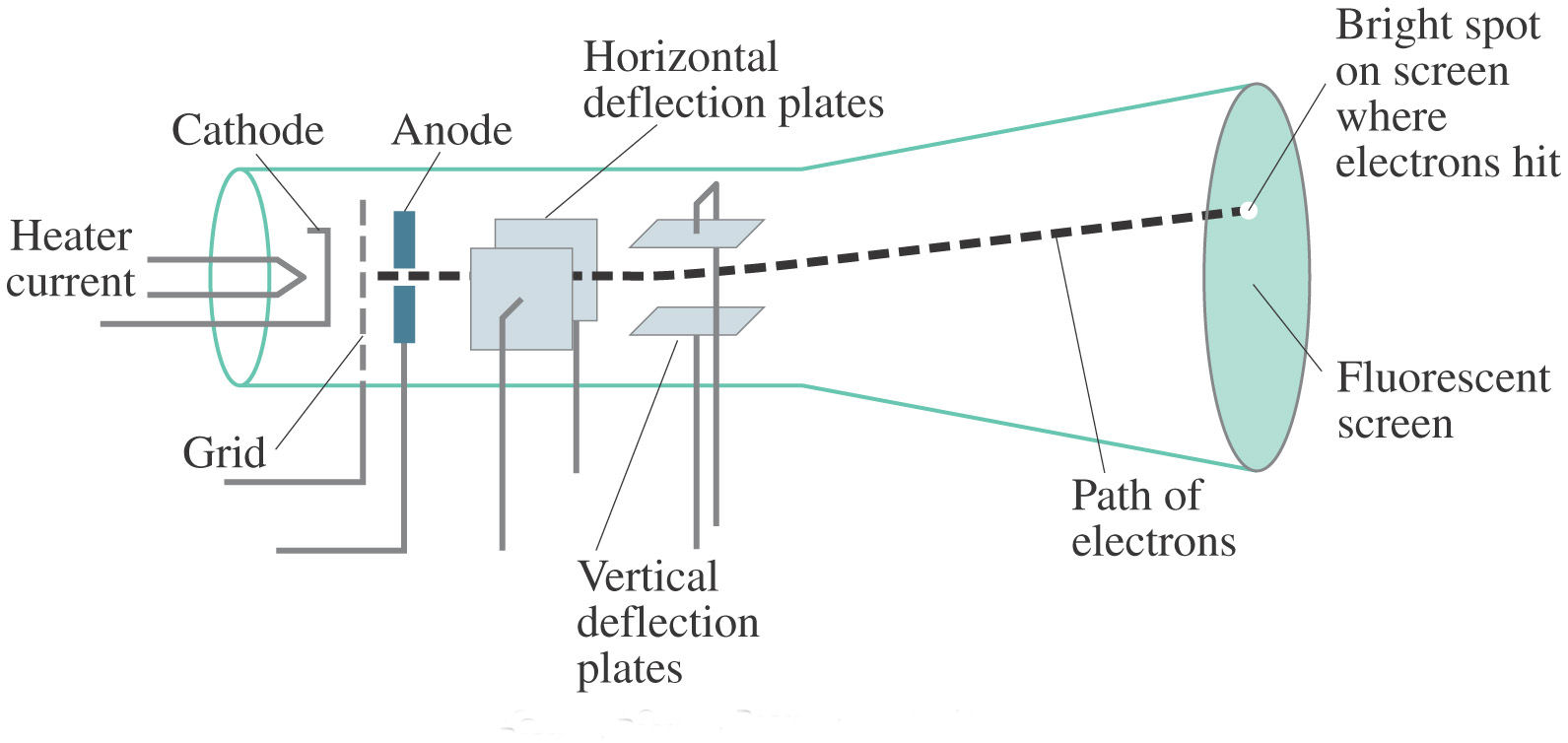
One of the classic applications is in cathode ray tubes, which were used in older television sets and computer monitors. In these devices, electrons are accelerated and deflected by electric fields to strike specific points on a screen, producing images.

|
| Figure 17.55 Cathode ray tube diagram (Source) |
2. Electron Beam Devices
Electron beams in devices such as electron microscopes are controlled using electric fields. The electric field directs and accelerates electrons so that they can produce highly detailed images of microscopic structures.

|
| Figure 17.56 Electron beams in devices such as electron microscopes are controlled using electric fields (Source: britannica) |
3. Particle Accelerators
Uniform electric fields are used in particle accelerators to increase the kinetic energy of charged particles. These accelerators are essential in nuclear physics, medical research, and the study of fundamental particles.
4. Mass Spectrometers
In mass spectrometers, electric fields are used to accelerate charged ions before they enter magnetic fields. This process helps scientists determine the mass-to-charge ratio of ions, allowing identification of chemical substances.
5. Electrostatic Deflection Systems
Electric fields can also be used to deflect charged particles in controlled directions. This principle is applied in beam steering systems and experimental physics instruments.
6. Inkjet Printing Technology
Some inkjet printers use electrostatic fields to control the motion of tiny charged ink droplets, ensuring accurate placement of ink on paper.

|
| Figure 17.57 The nozzle of an ink-jet printer produces small ink droplets, which are sprayed with electrostatic charge. Various computer-driven devices are then used to direct the droplets to the correct positions on a page. (Source: libretexts) |
17.6.6 Conclusion: Motion of Charged Particle in a Uniform Electric Field
The motion of a charged particle in a uniform electric field is governed by the constant electric force acting on the particle. Because the electric field is uniform, the force F = qE remains constant, causing the particle to experience constant acceleration in the direction of the field for positive charges and in the opposite direction for negative charges.
The type of motion depends on the particle’s initial velocity. If the particle enters the field parallel to the electric field, it undergoes uniformly accelerated straight-line motion. If it enters perpendicular to the field, the motion becomes parabolic, similar to projectile motion under gravity. When the velocity has components both parallel and perpendicular to the field, the resulting trajectory is also parabolic.
Understanding this concept is important because it explains the behavior of charged particles in many physical systems and technologies, including electron beams, cathode ray tubes, particle accelerators, and electrostatic deflection devices. Therefore, the study of charged particle motion in uniform electric fields plays a key role in electromagnetism and modern physics applications.
17.6.7 Frequently Asked Questions (FAQ) Motion of Charged Particle in Uniform Electric Field
1. What is the motion of a charged particle in a uniform electric field?
The motion of a charged particle in a uniform electric field occurs when a charged object experiences a constant force due to the electric field. This force causes the particle to accelerate in the direction of the field (for positive charges) or opposite to the field (for negative charges).
2. What force acts on a charged particle in an electric field?
A charged particle in an electric field experiences an electric force given by:
F = qE
where F = electric force, q = electric charge, E = electric field strength
3. How is the acceleration of a charged particle determined?
Using Newton’s Second Law, the acceleration of the particle can be written as:
a = F/m = qE/m
where m = mass of the particle
This shows that acceleration depends on the charge, electric field strength, and particle mass.
4. What type of motion occurs if the particle enters parallel to the electric field?
If a charged particle enters the electric field parallel to the field direction, the motion becomes uniformly accelerated linear motion, similar to an object moving under constant acceleration.
5. What happens if a charged particle enters perpendicular to the electric field?
If the particle enters perpendicular to the electric field, it experiences acceleration in the field direction while maintaining its initial velocity in the perpendicular direction. As a result, the trajectory becomes parabolic, similar to projectile motion.
6. Why does the path become parabolic?
The path becomes parabolic because:
- velocity in the horizontal direction remains constant
- acceleration occurs only in the vertical direction due to the electric force
This combination produces a parabolic trajectory, just like projectile motion under gravity.
7. What are some real-life applications of this concept?
Motion of charged particles in uniform electric fields is used in several technologies, such as:
- Cathode Ray Tubes (CRT)
- Electron beam devices
- Mass spectrometers
- Particle accelerators
- Electrostatic deflection systems
Post a Comment for "Motion of Charged Particle in Uniform Electric Field – Theory, Formula and Examples"